

National Accountability Framework

Accountability Is Everyone's Business

A National Framework to Strengthen Civil Society in Trinidad and Tobago

Explore the Full Framework

Created under the EU-funded project IGNITE CSOs (Improving Governance, Networking, Inclusivity Towards Empowered Civil Society Organisations)

The Cropper Foundation, Veni Apwann, and European Union partner logos
Illustration of a person saluting the Trinidad and Tobago national flag in front of a rising sun, palm trees, green hills, and blue water

1. WHY A NATIONAL ACCOUNTABILITY FRAMEWORK?

The Civil Society Sector of Trinidad and Tobago is a critical national development partner, along with the Public and Private Sectors. Securing the Sector's long-term sustainability is essential to our country's future and citizens' well-being. Demonstrating the highest levels of accountability is key for the Sector’s sustainability within the national legislative environment. Accountability is a cornerstone of effective and sustainable CSOs. It ensures that these organisations remain true to their missions, maintain trust with stakeholders, and deliver impactful services.

An accountability framework, which integrates the local context, legal requirements, and cultural factors, provides a structured approach for CSOs to demonstrate responsibility, transparency, integrity and effective governance.

Word cloud above diverse community figures showing types of Civil Society Organisations: civil-society-organisation, non-profit, voluntary-organisation, trade-union, faith-based, youth-club, village-council, drama-group, steelband, sports-club, cultural-club, residents-association, professional-association, philanthropic, advocacy-group, neighbourhood-watch, foundation, and community-group

2. WHO IS A CSO?

It’s easy to be confused by the term ‘CSO’, given the many labels and categories of organisations applied to entities within the Sector by government, donors, and even us! So, before going any further, have a look at the word cloud on your right for a clearer idea of who is considered a Civil Society Organisation.

We are many, aren’t we?

Now that you know we are speaking to you, let’s continue with the rationale for making ‘being accountable’ one of your organisation’s highest priorities!

Illustration of figures assembling colourful building blocks beneath overlapping yellow and green speech bubbles

Benefits & Consequences of Accountability

Comparison of benefits of civil society accountability and consequences of lacking accountability
Benefits of Civil Society Accountability Consequences of Lack of Civil Society Accountability
Promotes Transparency – Ensures organisations act openly and honestly, reducing corruption and misinformation. Increased Corruption – Lack of oversight can lead to unethical practices and misuse of resources.
Enhances Public Trust – Citizens are more likely to support and engage with organisations that operate responsibly. Erosion of Public Confidence – People may lose faith in institutions that act irresponsibly or dishonestly.
Encourages Responsible Governance – Holds authorities and organisations accountable for their actions and policies. Weak Governance & Poor Decision-Making – Leaders may act in self-interest rather than for the public good.
Boosts Civic Engagement – Encourages people to participate in social and political matters, leading to positive change. Public Disengagement & Apathy – Without accountability, people may feel powerless and disengaged from governance.
Strengthens Democracy – Ensures fair processes and decision-making, preventing abuse of power. Threat to Democratic Institutions – Weak accountability can result in authoritarian tendencies and erosion of rights.
Protects Human Rights – Upholds justice, equality, and protection for vulnerable groups. Increase in Human Rights Violations – Marginalised communities may suffer from unchecked discrimination or injustice.
Encourages Sustainable Development – Helps ensure long-term, fair distribution of resources. Unbalanced Growth & Social Inequality – Resources may be exploited without regard for future generations.

3. PRINCIPLES OF ACCOUNTABILITY

Accountability is a globally recognised governance principle that ensures an organisation’s leaders are held to the highest standards expected of them. Governing bodies that are held to account perform at their best and exercise proper oversight over those to whom they have delegated responsibility.

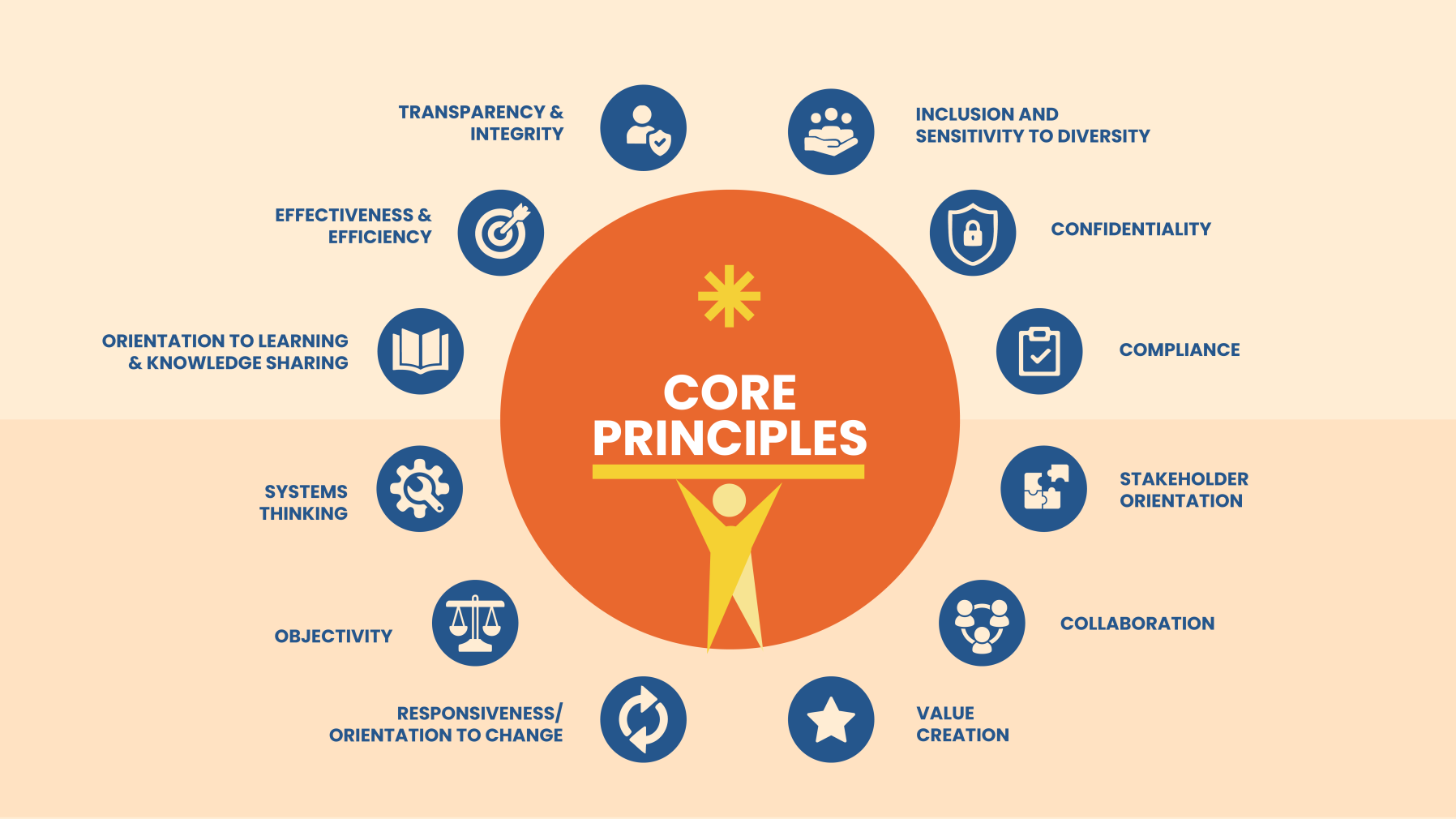
Diagram of the twelve Core Principles of Accountability arranged around an orange centre circle: Transparency & Integrity, Inclusion and Sensitivity to Diversity, Confidentiality, Compliance, Stakeholder Orientation, Collaboration, Value Creation, Responsiveness / Orientation to Change, Objectivity, Systems Thinking, Orientation to Learning & Knowledge Sharing, and Effectiveness & Efficiency
Core Principles: Transparency & Integrity; Inclusion and Sensitivity to Diversity; Confidentiality; Compliance; Stakeholder Orientation; Collaboration; Value Creation; Responsiveness / Orientation to Change; Objectivity; Systems Thinking; Orientation to Learning & Knowledge Sharing; Effectiveness & Efficiency.
Illustration of a Trinidad and Tobago coastal community gathering outside colourful buildings while volunteers pick up plastic bottles along the shoreline

4. KEY PRACTICES BY THEMATIC AREA

Standards of accountability go further to detail the specific actions a CSO should take to put accountability into practice.

Illustration of a leader presenting governance policies on a whiteboard to community stakeholders

4.1 Governance

Governing bodies (i.e. Boards of Directors, Executive Committees or Trustees) should prioritise business ethics, corporate responsibility, social mission and integrated thinking to balance current and future needs in the interest of the long-term sustainability of the organisation. Members of governing bodies should be independent in character and judgment, apolitical, and demonstrate strong fiduciary responsibility.

Key Practices:

  • Maintain oversight of the organisation’s operations.
  • Define clear roles and responsibilities.
  • Implement regular self-assessments and external evaluations of governance practices.
  • Drive the organisation’s sustainability and value creation.
  • Create and uphold policies that reflect the organisation’s values and compliance requirements.
Illustration of a green figure reflecting thoughtfully beneath an orange dollar-sign speech bubble

4.2 Financial Management

Financial accountability ensures proper use of funds, promotes sustainability, and builds trust with donors and beneficiaries.

Key Practices:

  • Develop and approve annual budgets aligned with strategic goals.
  • Practise participatory budgeting.
  • Maintain asset registers and strong internal controls.
  • Conduct annual audits and implement recommendations.
  • Use fund accounting systems where applicable.
  • Monitor and report financial data in a timely manner and clear format.
  • Comply with the Companies Act 1995 and the NPO Act 2019.

Good financial management leads to:

  • Reduced reputational risk
  • Greater donor confidence
  • Improved access to funding
  • Better risk management and M&E practices
Illustration of a diverse group of community members sharing ideas in yellow, green, and blue speech bubbles

4.3 Project Management

Projects must be designed, delivered and evaluated with transparency and stakeholder input.

Key Practices:

  • Establish clear performance indicators.
  • Conduct regular monitoring and evaluation.
  • Report transparently on outcomes, challenges, and impact.
  • Host public accountability forums (e.g. Gayap) to engage stakeholders.
  • Use tools like surveys and community forums to gather feedback.
  • Adapt programmes based on feedback and context changes.
Illustration of a blue figure reading an open handbook beneath a glowing lightbulb icon

4.4 Human Resource Management

HR accountability ensures that teams are motivated, qualified, and supported to carry out the organisation’s mission.

Strategic Practices:

  • Align HR strategy with mission and employment laws.
  • Promote inclusive hiring and merit-based promotions.
  • Collaborate with unions and foster respectful workplaces.
  • Fundraise strategically to support HR needs.

Operational Practices:

  • Use performance management cycles.
  • Create policies for remote work, data protection, and ethical conduct.
  • Encourage continuous learning and accountability.
  • Ensure safe, lawful working conditions.

5. STEPS TO PUT IT INTO ACTION

To support the integration of accountability into the day-to-day operations of CSOs, the NAF outlines a clear seven-step implementation strategy. This provides a structured yet flexible approach that organisations varying in size and capacity can adapt.

  1. 1. Assessment of Organisation’s Level of Accountability

    Begin by evaluating your current operations against the NAF’s principles and key practices. This self-assessment helps identify both strengths and areas for improvement.

  2. 2. Customisation

    Tailor your accountability approach based on the self-assessment. Not all practices may apply to every CSO. Identify priority areas for enhancement and realistic timelines for change.

  3. 3. Stakeholder Mapping and Engagement

    Identify key stakeholders—staff, volunteers, donors, beneficiaries, partners—and map their roles and interests. Engage them meaningfully in the accountability journey to ensure relevance, buy-in and inclusiveness.

  4. 4. Build CSO Capacity to Enhance Sector-Wide Accountability

    Raise awareness among your stakeholders about the importance of accountability and their role in achieving it. Offer training, mentorship, or access to toolkits that build necessary competencies.

  5. 5. Action Plan Development

    Develop a realistic and detailed action plan that outlines:

    • Specific activities and interventions
    • Timelines
    • Roles and responsibilities
    • Required resources.

    This plan becomes your roadmap to implementing the NAF within your organisation.

  6. 6. Monitoring and Evaluation

    Establish Key Performance Indicators (KPIs) to assess progress. Track implementation efforts, measure outcomes, and regularly review whether objectives are being met. Adjust as needed.

  7. 7. Continuous Improvement

    Accountability is not static. CSOs should revisit their practices routinely to reflect:

    • Changes in law or policy
    • Stakeholder feedback
    • Emerging sector trends and challenges
    • Organisational learning and reflection.
Winding yellow roadmap diagram showing the 7 implementation steps in sequence: 1 Organisational Assessment, 2 Customisation, 3 Stakeholder Mapping and Engagement, 4 Build CSO Capacity, 5 Action Plan Development, 6 Monitoring and Evaluation, and 7 Continuous Improvement